Microsoft just executed one of the most brazen forced-obsolescence maneuvers in the history of computing.
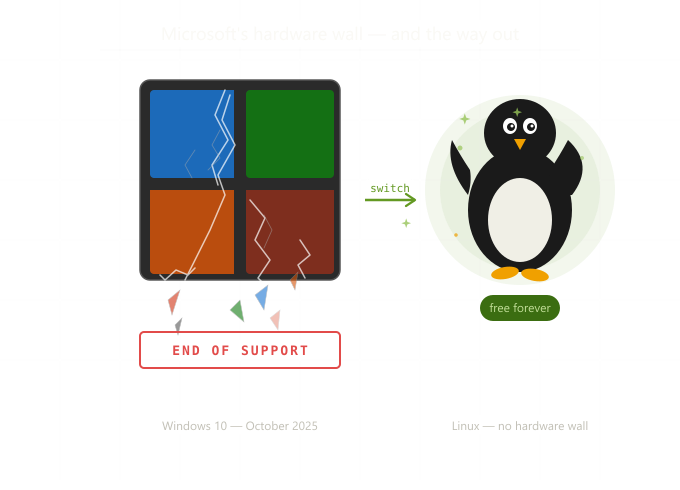
In October 2025, free security updates for Windows 10 officially ended. At that moment, over 60% of the world’s PCs were still running the OS. Microsoft’s “solution”? Upgrade to Windows 11. The reality? Tens of millions of those machines are physically barred from doing so.
This isn’t just a policy update; it’s a hardware wall. For small businesses, students, and retirees, Microsoft has issued an ultimatum: Buy new hardware, pay for “Extended Security Updates” (ESU), or operate a security liability.
The TPM 2.0 Trap: An Arbitrary Line in the Sand
The primary culprit is TPM 2.0 (Trusted Platform Module). While Microsoft frames this as a “non-negotiable” security requirement for their “Zero Trust” architecture, as an infrastructure engineer, I see it differently.
A 2017-era laptop with an Intel Core i5 and 16GB of RAM is a highly capable machine. It is more than sufficient for 95% of business operations. Yet, because it lacks a specific version of a security chip, Microsoft has declared it “e-waste.”
The data is staggering: Three years after the launch of Windows 11, it barely reached 35% market share. This wasn’t user stubbornness—it was a hardware wall that small business budgets simply couldn’t scale.
The Hidden Cost of Compliance
For a small business owner, this isn’t just an OS update; it’s a capital expenditure crisis.
- The Hardware Tax: Replacing a fleet of 10 functional workstations costs $5,000–$10,000.
- The Subscription Trap: Microsoft’s ESU program starts at $30https://www.google.com/search?q=/year per device and scales upward, with no long-term price cap.
The Engineer’s Take: We are seeing functional, high-quality silicon being sent to landfills not because of hardware failure, but because of a licensing strategy.
Linux in 2026: The Business-Grade Alternative
Here is the part the tech press often misses: Linux isn’t a “compromise” anymore.
In my 20+ years of running Linux infrastructure, I have watched the “compatibility gap” vanish. If your business lives in a browser—using Google Workspace, Microsoft 365 Web, Zoom, Slack, or Canva—you don’t need Windows. You need a stable kernel and a secure browser.
Distributions like Linux Mint or Zorin OS offer:
- Zero Licensing Costs: Free to download, free to update, forever.
- Extended Hardware Life: That “obsolete” 2017 laptop will often run faster on Linux than it ever did on Windows.
- Industrial Stability: Linux is the backbone of the world’s servers (including the ones I manage in Houston). Bringing that stability to your desktop is the ultimate “productivity hack.”
The Infrastructure Connection: Why This Matters to Your Website
If you are a business owner rethinking your desktop OS, you should be rethinking your web infrastructure too.
The same “forced obsolescence” and “black-box support” you see in Windows is rampant in the hosting industry. Most “Big Hosting” companies put your site on crowded, unmanaged servers and hope you don’t notice when things slow down.
I take a different approach. Just as I advocate for the longevity and transparency of Linux on the desktop, I provide Private Linux-Based Infrastructure for your WordPress site.
- No arbitrary hardware walls.
- No “Level 1” support queues.
- Just pure, engineer-tuned performance.
Stop Letting Microsoft Dictate Your Budget
You don’t have to comply with a hardware roadmap designed to sell more laptops. Whether you are a student on a budget or a business owner managing a fleet, there is a path that values Engineering over Marketing.
Your Next Steps:
- Read the Hardware Guide: Will Linux Run on Your Computer?
- Secure Your Infrastructure: If you’re moving your business to Linux, ensure your website is running on an equally stable environment. Explore my Managed Hosting & Reliability Plans.
Leave a Reply